
Understanding Modern Cultivar Classification Beyond Indica/ Sativa

For decades, the cannabis world has been governed by a simple, seemingly intuitive binary: Indica for relaxation and body highs, Sativa for energy and cerebral effects. This framework has been the primary tool for consumers and budtenders alike to predict a strain’s effects. However, modern science reveals this model is not just oversimplified. It is fundamentally flawed and obsolete.
Welcome to the new era of cannabis understanding, where Modern Cultivar Classification relies on hard chemistry, not outdated botanical labels. This guide will dismantle the old myth and equip you with the scientific knowledge of chemotypes and terpene profiles to accurately predict effects and make empowered choices.
The Indica/Sativa Myth: Why the Old Model Fails
The persistence of the Indica/Sativa dichotomy is a case study in how historical accident can become entrenched dogma. Let’s break down why it no longer serves the modern consumer.
A Botanical, Not Chemical, Distinction
The terms Cannabis indica and Cannabis sativa were coined in the 18th century by naturalists like Jean Baptiste Lamarck. Their classification was based solely on plant morphology: leaf shape, plant height, and bush structure observed in different geographical regions. Indica plants from the Hindu Kush mountains were short and bushy with broad leaves, while Sativa plants from equatorial regions were tall and lanky with narrow leaves. These terms described physical form, not chemical makeup or psychoactive experience.
The Problem with Modern Hybrids
Today, after decades of intensive cross breeding, nearly all commercially available cannabis is a hybrid. The genetic lineage is so complex that a strain labeled “60% Indica, 40% Sativa” is a meaningless marketing estimate, not a scientific measurement. Two plants from the same “Indica dominant” batch can produce wildly different chemical profiles and effects.
Why Effects Are Misattributed
If the old model is wrong, why do so many people swear by it? The perceived differences often stem from:
- Confirmation Bias: Users expect a certain effect based on the label and perceive their experience accordingly.
- Cultivation & Harvest Factors: A plant harvested earlier (with clear trichomes) can produce more energetic effects, while the same plant harvested later (with amber trichomes) may be more sedative.
- The Real Drivers: The effects we do feel are actually driven by the plant’s chemical composition primarily its cannabinoid ratio and terpene profile which are entirely independent of its physical Indica or Sativa stature.
The New Standard: Classification by Chemotype (Cannabinoid Ratios)
The modern, science backed approach classifies cannabis by its chemotype (chemical phenotype) the specific profile of cannabinoids it produces. This is the most critical factor in determining a strain’s potential effect.
What is a Chemotype?
A chemotype is a classification based on a plant’s dominant chemical constituents. For cannabis, this primarily refers to the ratio of Tetrahydrocannabinol (THC) to Cannabidiol (CBD), the two most abundant cannabinoids. This ratio is genetically determined and provides the foundational framework for the plant’s effect. Read this comprehensive guide to THC to educate yourself.
(Note: For a deep dive on its acidic precursor, learn about the fundamental difference between THCa and THC).
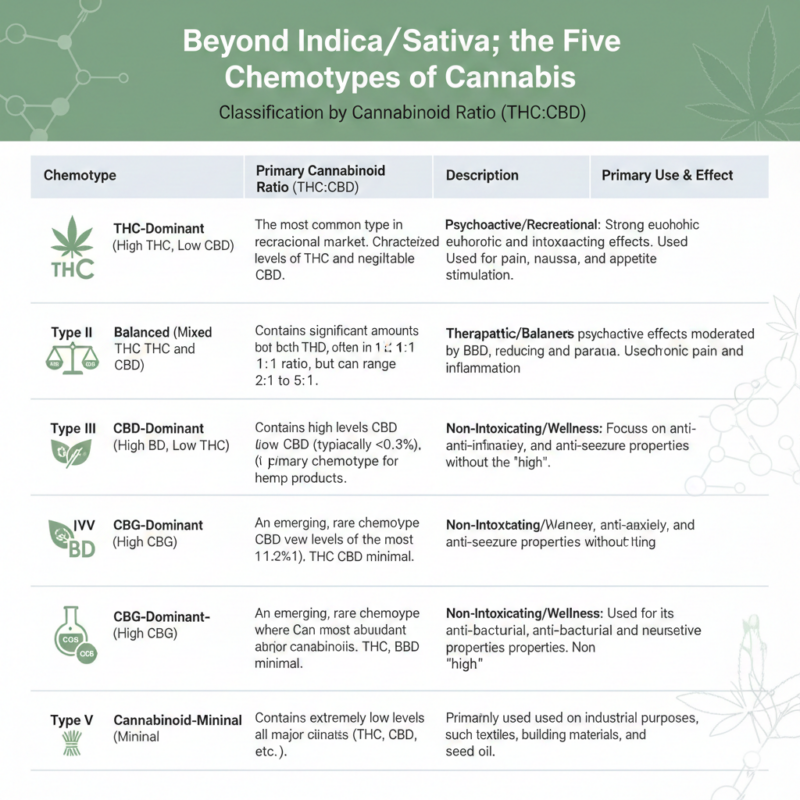
The Five Primary Chemotypes
Researchers commonly categorize cannabis into five main chemotypes:
| Chemotype | THC:CBD Ratio | Primary Use & Effect |
|---|---|---|
| Type I | THC Dominant | High THC, negligible CBD. The classic “drug type” cannabis, associated with pronounced psychoactive effects. This chemotype is used to produce extremely potent concentrates like high-purity THCa diamonds. |
| Type II | Balanced/Mixed | A spectrum of balanced THC and CBD ratios (e.g., 1:1, 2:1). CBD modulates THC’s intensity, often resulting in a clearer, more functional experience. |
| Type III | CBD Dominant | High CBD, very low THC (<0.3%). Non intoxicating, primarily associated with therapeutic applications. |
| Type IV | CBG Dominant | Emerging type where Cannabigerol (CBG) is the dominant cannabinoid. Valued for specific therapeutic research. |
| Type V | Cannabinoid Minimal | Negligible levels of all major cannabinoids. Historically used for fiber and industrial purposes. |
Choosing your chemotype is step one. If you seek intense psych activity, look for Type I. For a moderated, therapeutic effect, Type II or III is your starting point.
The Terpene Factor: Predicting Effects Beyond Cannabinoids
If chemotypes are the foundation, terpenes are the interior design. These aromatic compounds found in all plants are responsible for cannabis’s distinctive smells (pine, citrus, diesel, lavender) and, crucially, they modulate and direct the effects of cannabinoids through the “Entourage Effect.”
What is the “Entourage Effect”?
This theory, supported by growing evidence, posits that cannabis compounds work synergistically. Terpenes can influence how cannabinoids like THC bind to receptors in your brain, thereby shaping the subjective experience whether a strain is calming or uplifting, focusing or sedating.
Key Terpenes and Their Associated Effects
Understanding dominant terpenes allows you to fine tune your selection within a chosen chemotype.
| Terpene | Common Aroma | Suggested Influence & Effects |
|---|---|---|
| Myrcene | Earthy, Musky (like cloves) | Sedating, relaxing. High levels are strongly associated with “couch lock” effects, often mislabeled as “Indica.” |
| Limonene | Citrus (lemon, orange) | Uplifting, mood elevating, anti stress. Often dominant in strains mislabeled as “Sativa.” |
| Caryophyllene | Spicy, Peppery (black pepper) | Anti inflammatory, analgesic. Unique because it directly binds to CB2 receptors, acting like a cannabinoid. |
| Pinene | Pine (pine needles, rosemary) | Alerting, memory retention, bronchodilator. Can counteract some of THC’s short term memory impairment. |
| Linalool | Floral (lavender) | Calming, anti anxiety, sedative. Promotes deep relaxation and stress relief. |
A Type I (THC dominant) strain rich in limonene and pinene will likely provide an energetic, focused creative burst. That same Type I strain rich in myrcene and linalool will likely lead to deep relaxation and sleep, despite both being called “Indica” or “Sativa” in a dispensary.
How to Use Modern Classification to Choose Your Strain
Forget the old labels. Use this actionable, three step method to find your perfect match.
- Step 1: Prioritize the Chemotype (THC:CBD Ratio).
- Ask yourself: What is my primary goal? Strong psychoactive experience? Mild relaxation without strong intoxication? Pure therapeutic effect without a “high”? Your answer points you to Type I, II, or III.
- Step 2: Analyze the Top 3 Terpenes.
- Within your chosen chemotype, look for the dominant terpenes. Match them to your desired outcome:
- Sleep/Deep Relaxation: Seek Myrcene, Linalool.
- Energy/Creativity/Mood: Seek Limonene, Pinene.
- Pain/Inflammation Relief: Seek Caryophyllene.
- Within your chosen chemotype, look for the dominant terpenes. Match them to your desired outcome:
- Step 3: Ignore the Strain Name. Focus on the Certificate of Analysis (CoA).
- The strain name (e.g., “OG Kush,” “Blue Dream”) tells you nothing reliable about its chemistry in 2024. The only trustworthy source is the CoA, a lab report from third party testing.
- A savvy consumer always asks for the CoA. It will list the precise percentages of THC, CBD, and other cannabinoids (confirming the chemotype) and a detailed breakdown of the terpene profile.
Conclusion: The Future of Cannabis is Chemical
The transition from the Indica/Sativa myth to Modern Cultivar Classification marks cannabis’s maturation from a folk remedy to a subject of serious scientific inquiry. The old model, based on how a plant looks, has been decisively replaced by a new model based on what’s inside it: its chemotype and terpene profile.
Once you’ve selected the perfect chemotype and terpene profile, you’ll need the right consumption method. Learn how to consume concentrates like dabs and waxes.
Key Takeaways:
- Indica/Sativa describes plant shape, not effect.
- Chemotype (THC:CBD ratio) is the primary determinant of a strain’s potential strength and type of effect.
- Terpenes are the secondary modifiers that sculpt and direct the experience within a chemotype.
- The Certificate of Analysis (CoA) is your only reliable guide.
On your next dispensary visit, be an empowered consumer. Tell your budtender, “I’m looking for a Type II strain with high limonene,” or “Show me a Type I with dominant myrcene.” Ask to see the CoA. By demanding this level of detail, you not only ensure a better personal experience but also drive the entire industry toward greater transparency and scientific rigor.
The future of cannabis is personalized, precise, and chemical. It’s time to speak the language.